How I got my Bachelor’s and Master’s in AI in five months and $10k
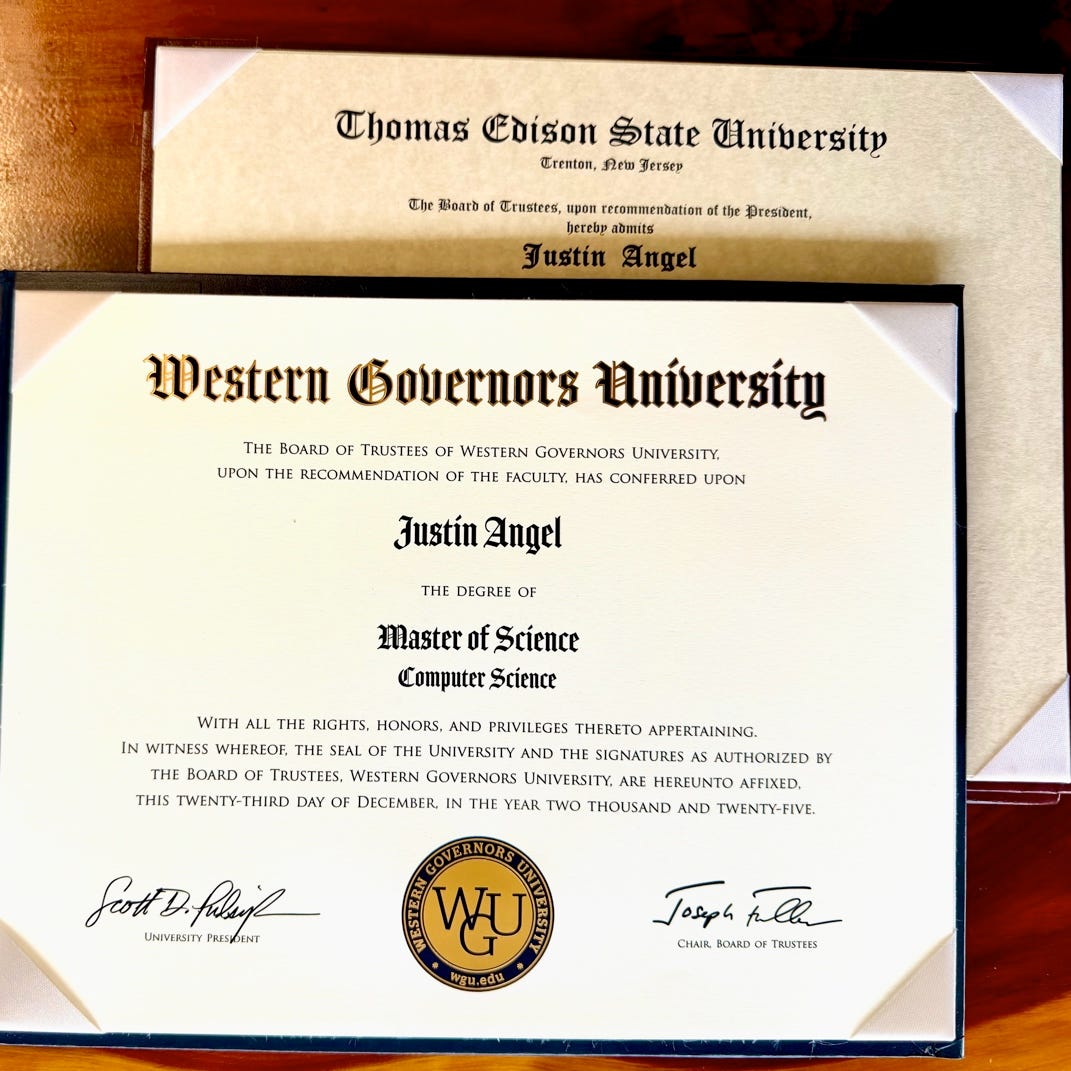
Twenty years ago I dropped out of college to start my own business. In 2025, I enrolled and completed both an undergraduate and master’s degree in computer science as an intellectual pursuit. It took less than five months and cost approximately $10k by speedrunning accumulating credits. I’m pretty established in my career (e.g., L8/principal engineer in FANG), so this wasn’t about career advancement. It was about enjoying shifting my attention towards AI/ML.
And there was lots of enjoyment in this process. The structure provided by the programs with their clear-cut expectations led to satisfaction and up-leveled my skills. I remember happily wandering the green fields of the Capodimonte in Napoli eating a pizza while listening to audio lectures on American history thinking “it doesn’t get better than this”. Completing courses in a single day ticked a lot of my emotional-validation boxes. And these new technical skills I gained in machine learning turned out to be tremendously useful.

This post is a how-to guide to those readers interested in replicating my process. Once reading about specific undergraduate credit sources becomes overwhelming for you, just scroll down to the master’s degree section.
Undergraduate: TESU and online courses
The TESU (Thomas Edison State University in New Jersey) degree programs are ideal for adult-learners who both have extensive prior knowledge and acquired learning-as-a-skill. I chose an undergraduate major in computer science, since that’s my area of expertise. My undergraduate degree is primarily cobbled together from online coursework and exams that were then post hoc recognized and included in the degree. This post will explore the mind-numbing technical minutiae of various credit sources.
Why have multiple credits sources?
My #1 priority was speedrunning this undergrad, as time is my one non-renewable resource. TESU is great for that. TESU degrees can be accelerated by having external companies evaluate existing knowledge for credit equivalency. However, each credit provider has its own time horizon and cost. As such, TESU students mix and match credit sources based on their preferred learning style, cost, and/or speed. Ultimately, I optimized for speed.
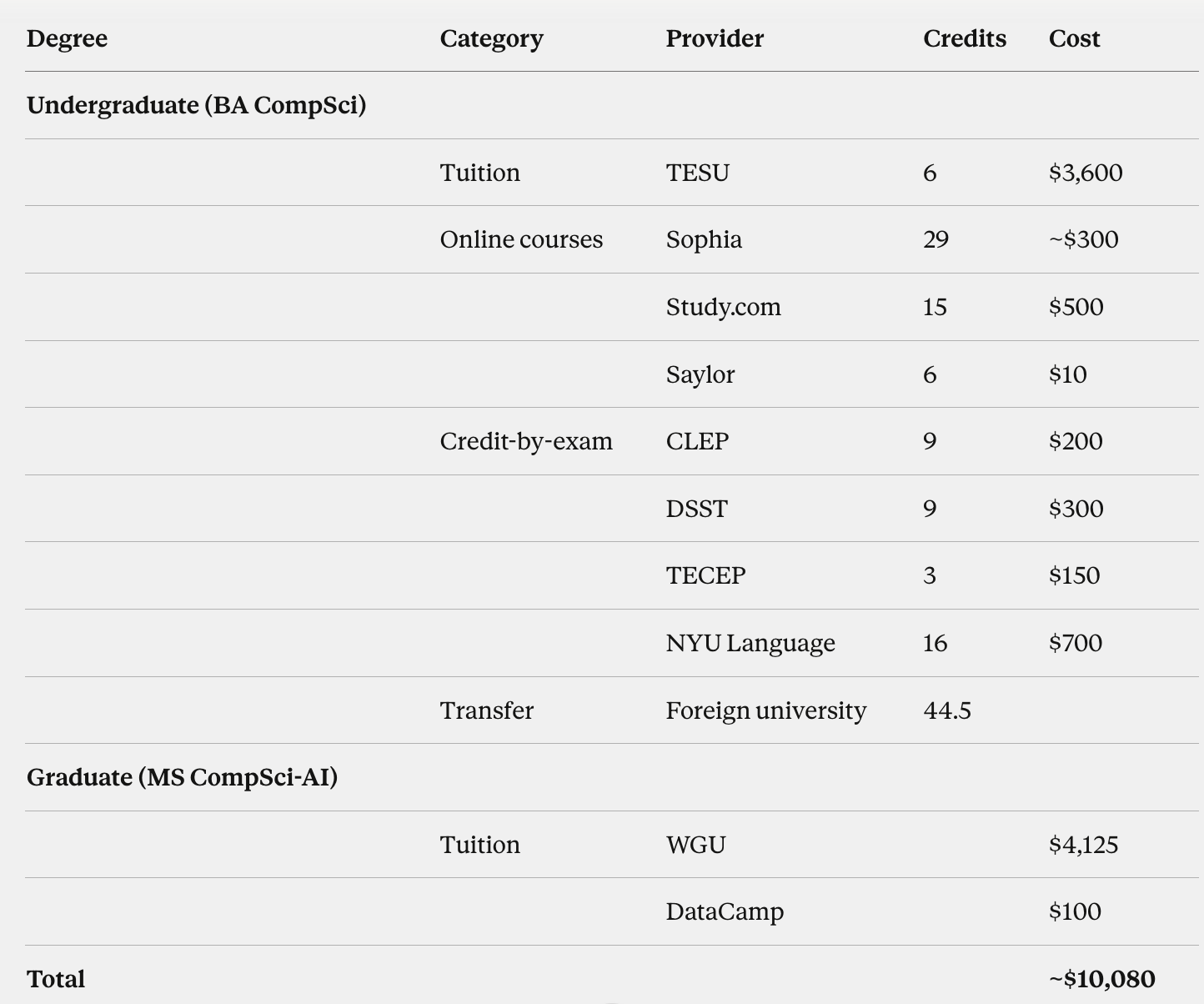
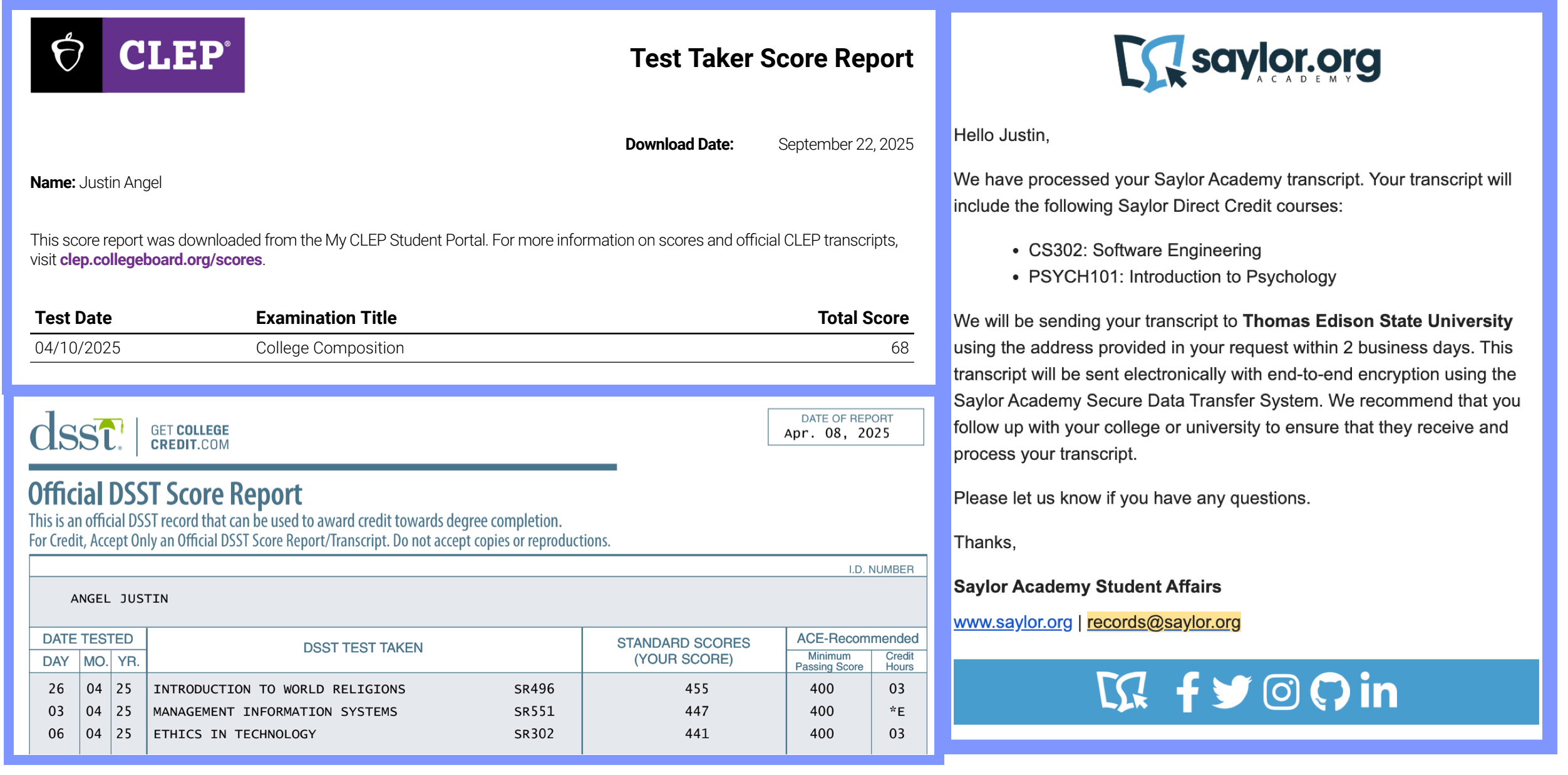
TESU accepts credits from multiple sources, such as TESU coursework, credit-by-exam, online courses, and prior learning from other institutions. Courses at TESU take 3 months and cost ~$500 per-credit, whereas a Sophia online course can be completed in a few days for ~$10 per-credit. Big difference. Upon completion, providers send official transcripts to TESU for evaluation and recognition. As a concrete example, TESU requires undergrads to demonstrate college-level writing proficiency. I took an online CLEP “college composition” exam for ~$90 and had 6 credits recognized within a week (~$15 per-credit). Effectively, TESU collaborates with external credit providers to validate their degree requirements are met.
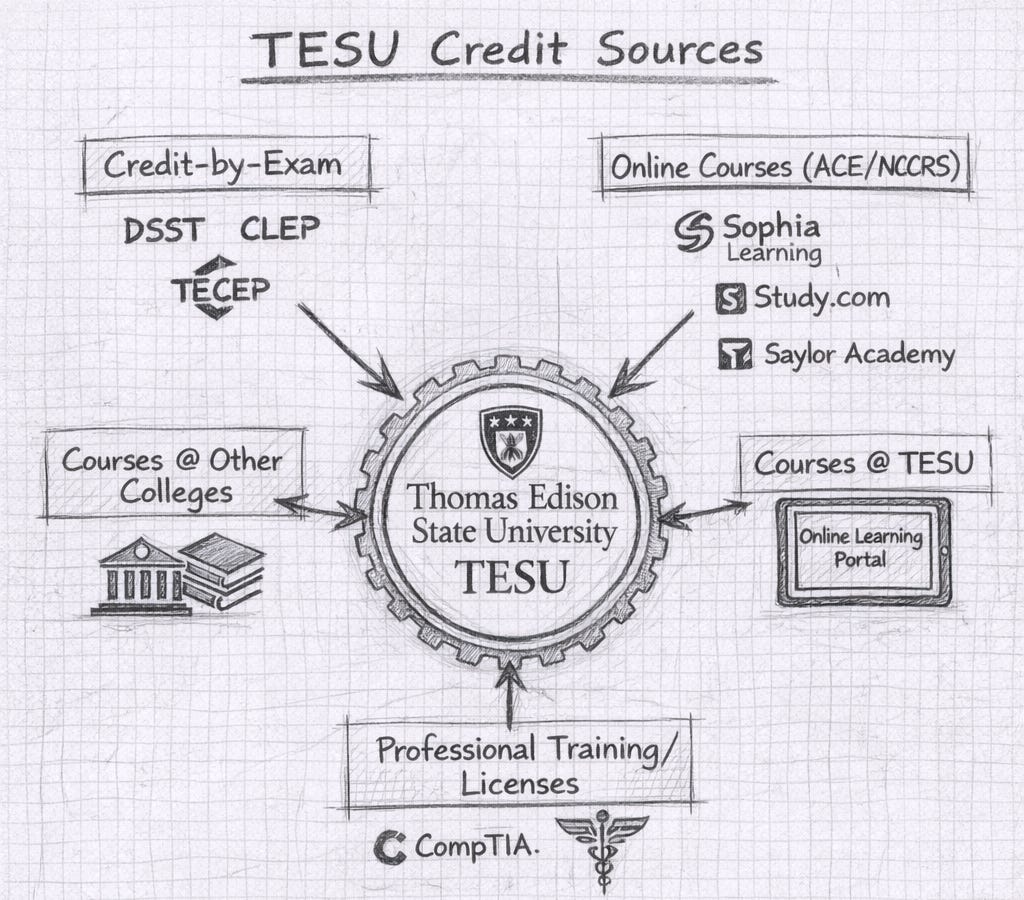
TESU online courses take about 3 months to complete, or you can test out of those immediately if you already have that knowledge. In the interest of expediency, I favored demonstrating knowledge over undertaking performative education. I found it much faster to knock out several course requirements each week based on knowledge I previously possessed. I owe this degree to the flexibility of not having to kabuki-theater my way through the higher-education system.

The TESU bachelor of arts in computer science degree requires 120 credits with a very specific breakdown. You can’t just collect 120 CompSci-related credits and call it a degree. Rather, credits must be equivalent to specific courses or applied to specific niche categories. For example, the degree requires Calculus 1 or an equivalent course, which I completed online with Sophia over three days. For category requirements, 15 credits must be “upper-level”/advanced credits which I predominantly completed with StudyDotCom and Saylor. Only 30 credits are free electives that don’t need to correlate to specific courses or categories. I assigned most of these electives towards math and CompSci, but I could’ve chosen music theory or culinary history.
Credit source #1: Credit-by-exam
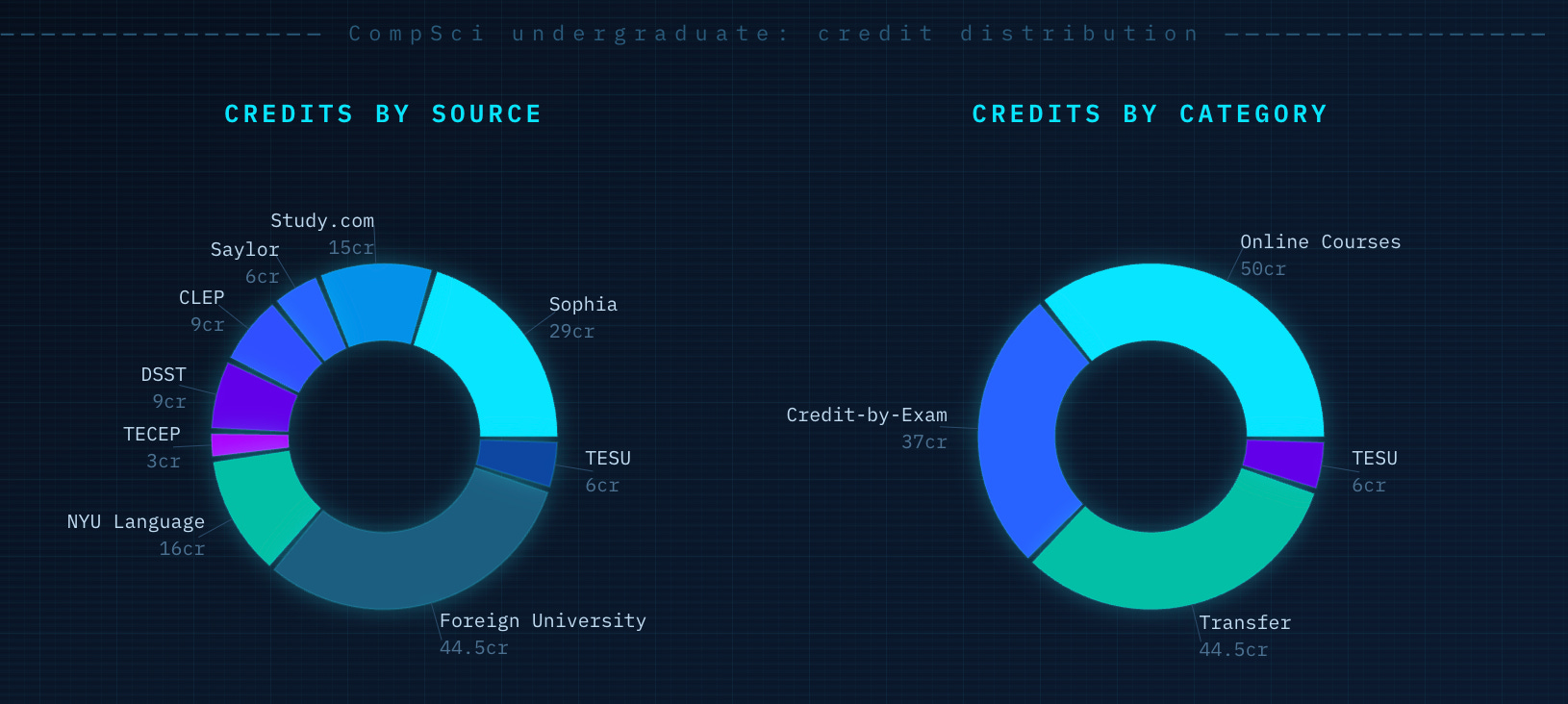
Credit-by-exam providers such as CLEP, DSST and TECEP allow you to take remote-proctored exams and earn credits the same day. These are primarily designed for armed forces service members and high school students, but they provided me a straightforward way to complete 21 of the 120 required credits. Exams ranged from nutrition and world religions, to ethics and writing. To me as a well-read adult, these exams required more courage than preparation. For each exam, I bought $20 worth of preparation materials, had ChatGPT/Claude summarize those, and read through the bullet points prior to the tests. These summaries allowed me to brush up on college-level material I was already familiar with.
The possibility of failing an exam and the over-formality of the proctored tests led me to deprioritize this format. It just isn’t fun to sit on camera answering questions as someone periodically demands you empty your pockets. Pursuing credits through online courses was more enjoyable, less emotionally taxing, and much more affordable.
Credit source #2: Online courses
Online courses accredited by ACE & NCCRS accounted for 50 of my 120 credits. I took 29 credits with Sophia.org, 15 with Study.com, and 6 with Saylor.com. Courses on Sophia have non-proctored final exams with mixed assignment formats including essay writing, coding projects, multiple-choice questions, and video recordings. Sophia courses included math (e.g., Calculus 1), programming (e.g., Java), humanities (e.g., public speaking), and science (e.g., nutrition). StudyDotCom online courses focused on upper-level coursework in computer science (databases, operating systems, architecture, etc) through multiple-choice quizzes and essays. Additionally, I took six credits with Saylor online courses and they only required proctored multiple-choice questions.
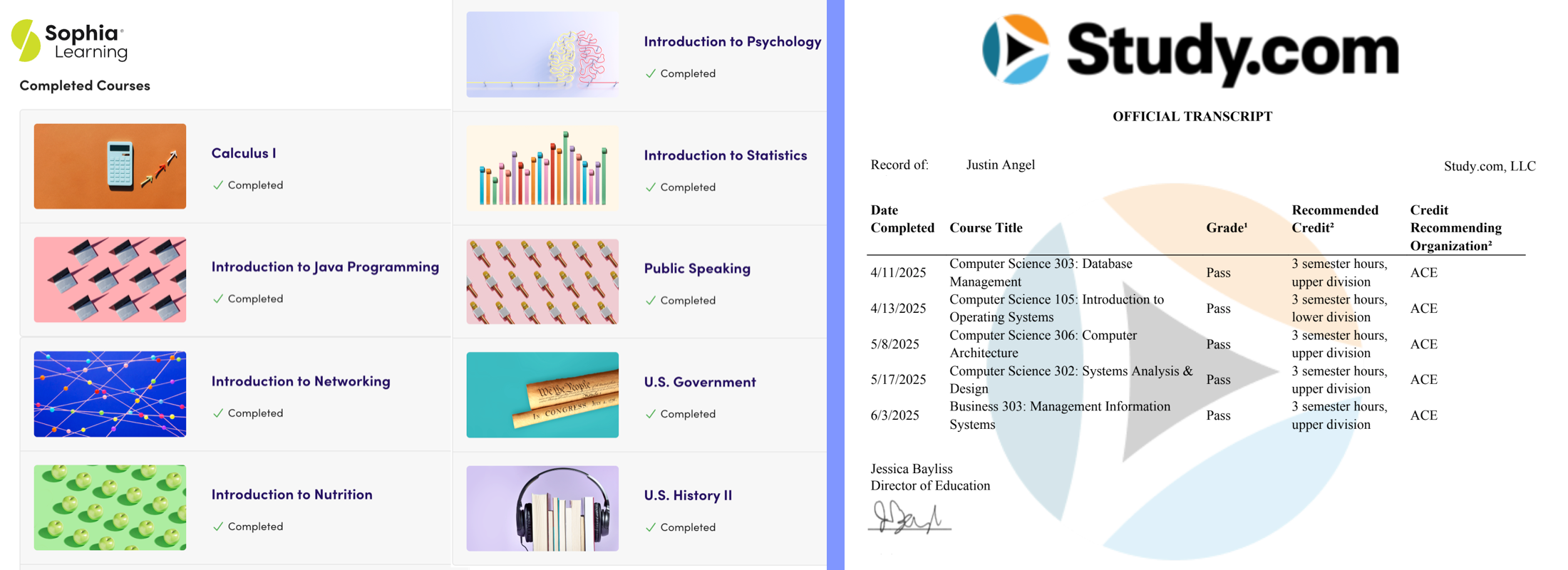
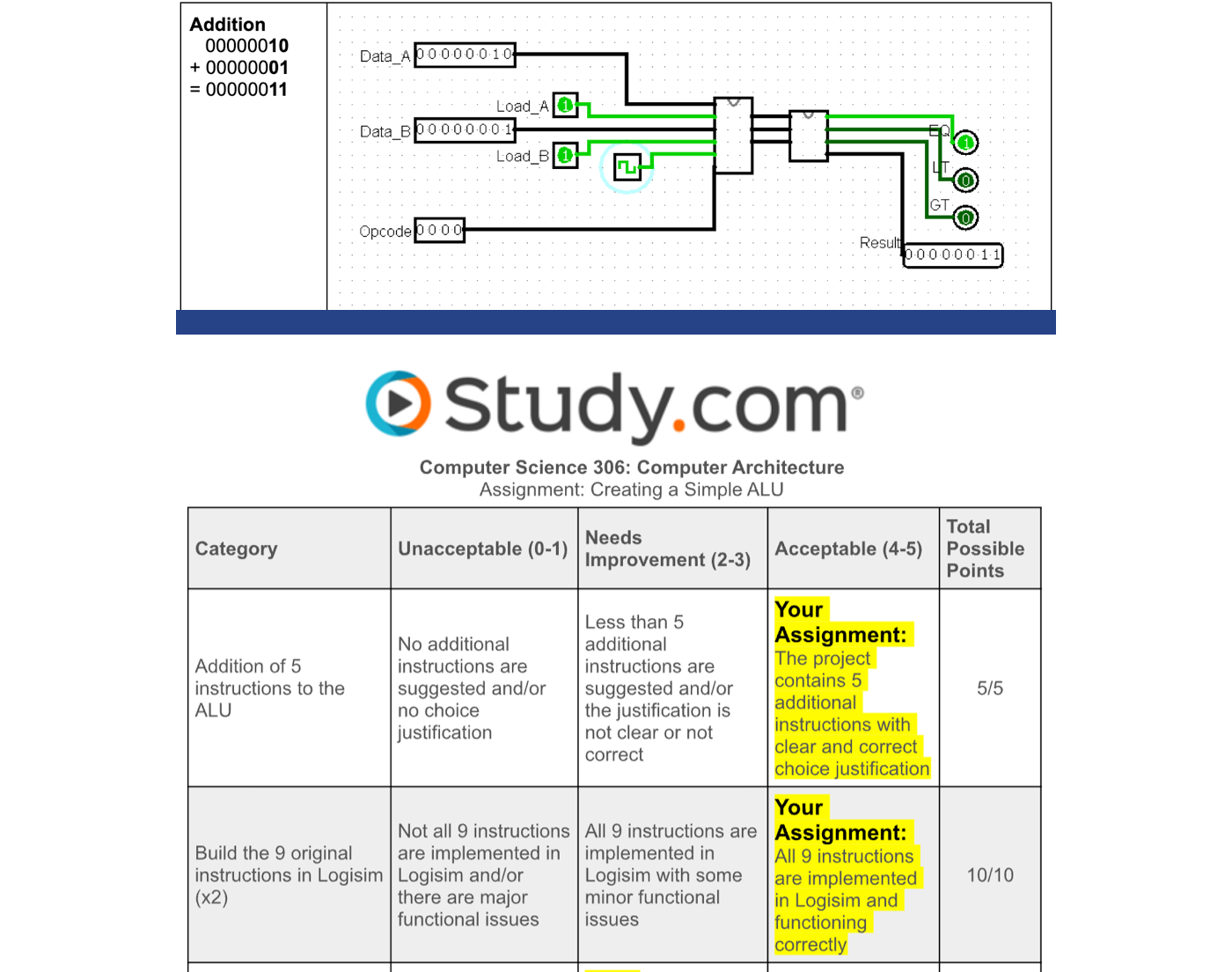
Online courses were by far the most enjoyable part of the degree. Self-paced learning across myriad fields delivered contentment & dopamine, bridged knowledge gaps, and felt emotionally supportive. Since both Sophia and Study allow retries, I experienced less anxiety and perfectionism and just did stuff. Some tricky assignments actually took multiple attempts to get to a perfect score. For example, developing a functioning circuit design for an ALU (Arithmetic Logic Unit, part of a CPU) took several attempts to complete StudyDotCom’s course requirements to prove it’s doing binary math correctly. What could’ve been a stressful experience, ended up instead as both enjoyable and educational.
Credit source #3: Language Proficiency exam
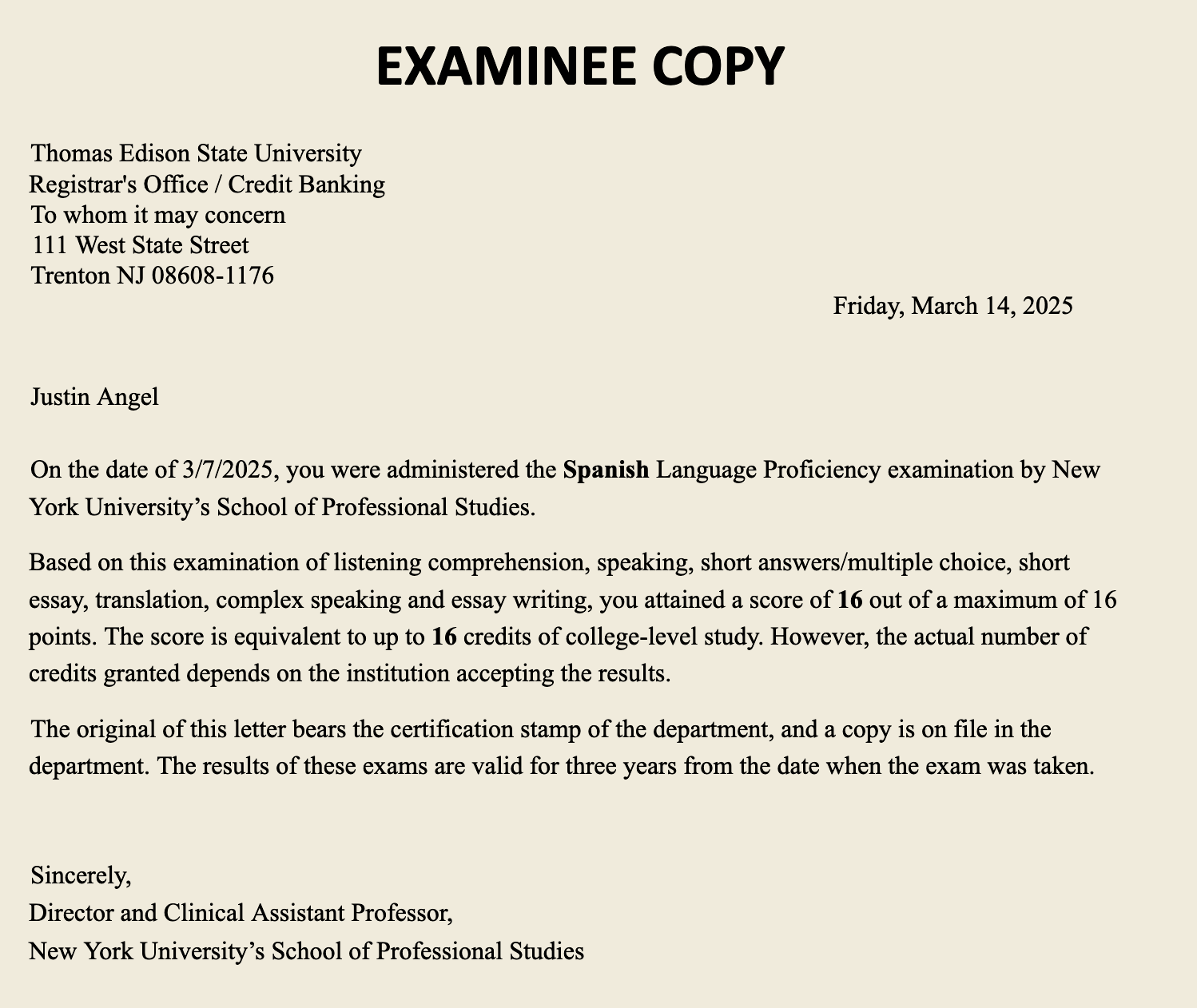
NYU’s Language Proficiency exam translated my multilingual fluency into 16 credits towards a TESU degree. Pun intended. The exam required everyday C2-level language fluency in Spanish across reading, speaking, listening, and writing. That exam itself was genuinely challenging and tested what a native speaker living in a Spanish-speaking country would do day-to-day. Results took several days with most credits ending up in the elective categories for me.
In a sense, this is a good example of how credit-by-exam serves an adult-learning population. Instead of the theatrics of sitting through Spanish classes, shouldn’t learners be allowed to demonstrate sufficient competency?
Credit source #4: Transfer Credits
Transferred credits from a foreign university accounted for 44.5 credits. As mentioned earlier, I dropped out of college in 2006 with 50 credits. SpanTran evaluated those credits with a 6:5 ratio (unclear why that ratio was applied). Those credits partially satisfied specific course requirements in computer science such as discrete math, linear algebra and data structures. I chose SpanTran to perform this evaluation because they directly contacted the foreign university and got the transcripts without my help.
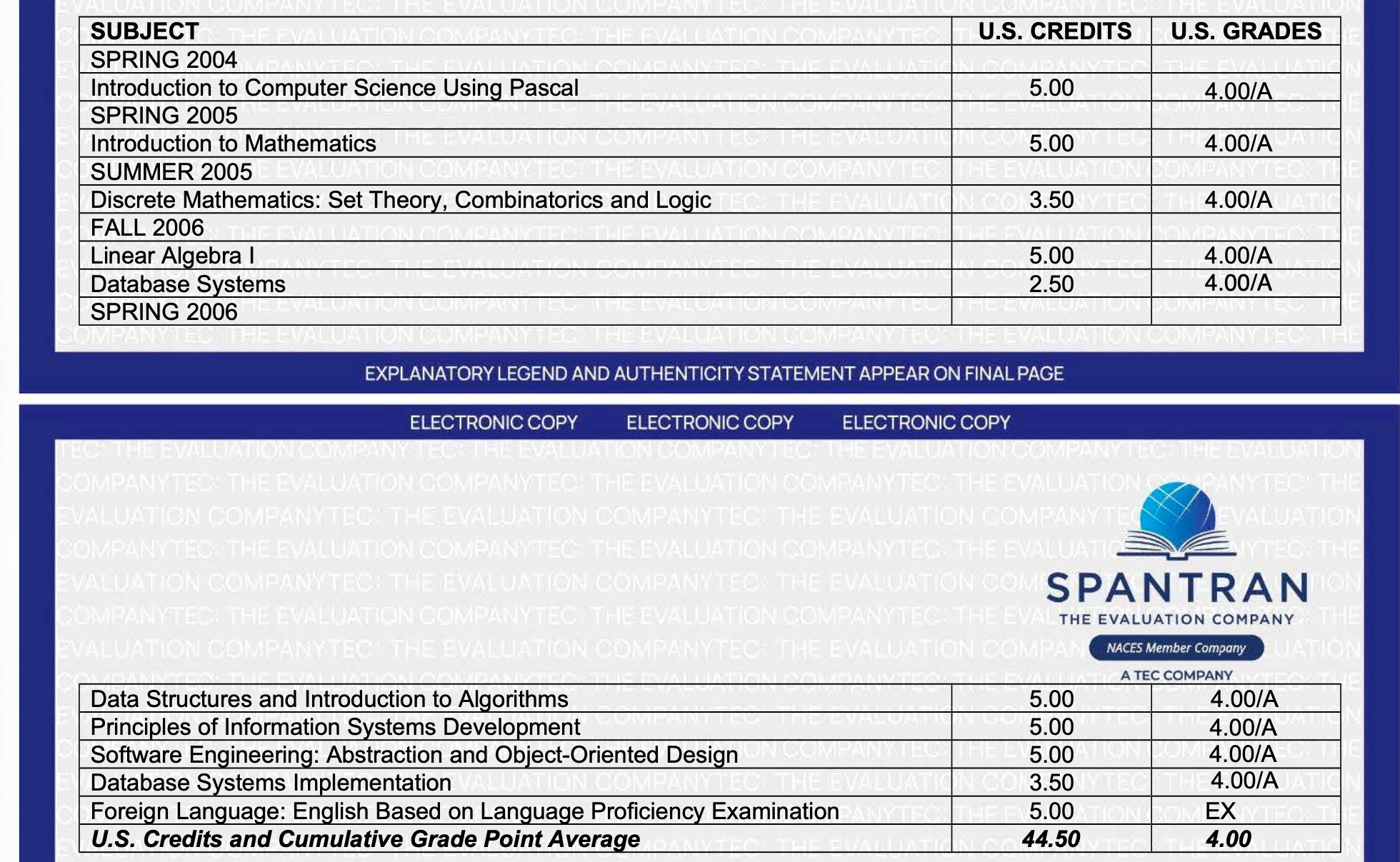
An important caveat: TESU requires that at least 30 credits be taken at TESU or transferred from another school. My transfer credits from twenty years ago covered that requirement. Though for those considering a similar path without prior credits, a common option is to start a WGU CompSci undergrad and then transfer those credits to TESU. Alex Sheppe covers the intricacies and limitations of this path in this video.
Credit source #5: TESU coursework
TESU coursework accounted for six credits. TESU requires that two courses be completed with them: a capstone thesis-writing course and a cornerstone media literacy course. Both courses involve weekly coursework including readings, graded essays, discussion forum participation, multiple-choice quizzes, and more. Since those courses take 3 months to complete start-to-finish, they’re the slowest part of getting the undergraduate. Under certain conditions it’s possible to parallelize these courses, which I did.
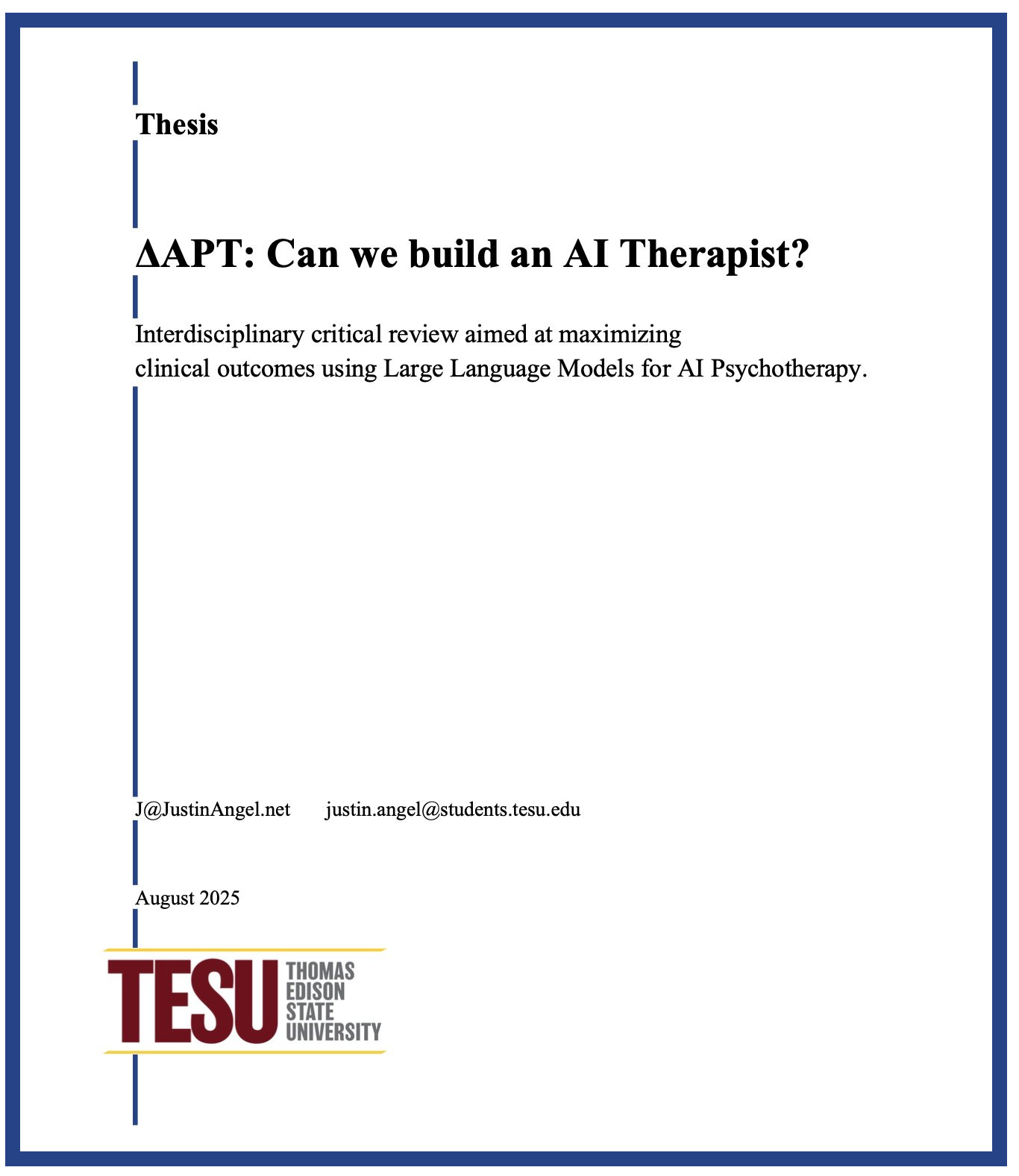
I took my thesis writing course quite seriously, read 200 academic papers and wrote a 112-page undergraduate thesis on AI-driven psychotherapy. Since publishing it I’ve received positive feedback and it’s painstakingly slowly going through academic publishing.
Was this undergrad worth it?
Yeah, but for unexpected reasons beyond being a prerequisite for a graduate-level education or career advancement. I found real joy in having structure that encouraged me to focus on topics I normally wouldn’t, like history, psychology, and civics. I enjoyed the slightly subversive element of cranking out an undergraduate degree in three months instead of four years. And I got satisfaction seeing myself earn 3 credits (or 1/40th of an undergraduate) in a single day or two. Spending a few hours in the evenings doing coursework in quaint Italian coffee shops provided grounding in an otherwise turbulent year.

Master’s degree: WGU and Machine Learning
AI chatbots will fundamentally shift the nature of knowledge work, including software engineering. Any software engineer who doesn’t have an intrinsic grasp of AI risk becoming unemployable. Red flags went up when an LLM architecture intro read like hieroglyphic gibberish to me. Was I headed to career obsolescence without in-depth AI/ML knowledge? That anxiety grew within me when I couldn’t scroll twitter without failing to understand the importance of the latest round of AI/LLM research. If you can’t beat the AI hype cycle, you join it.
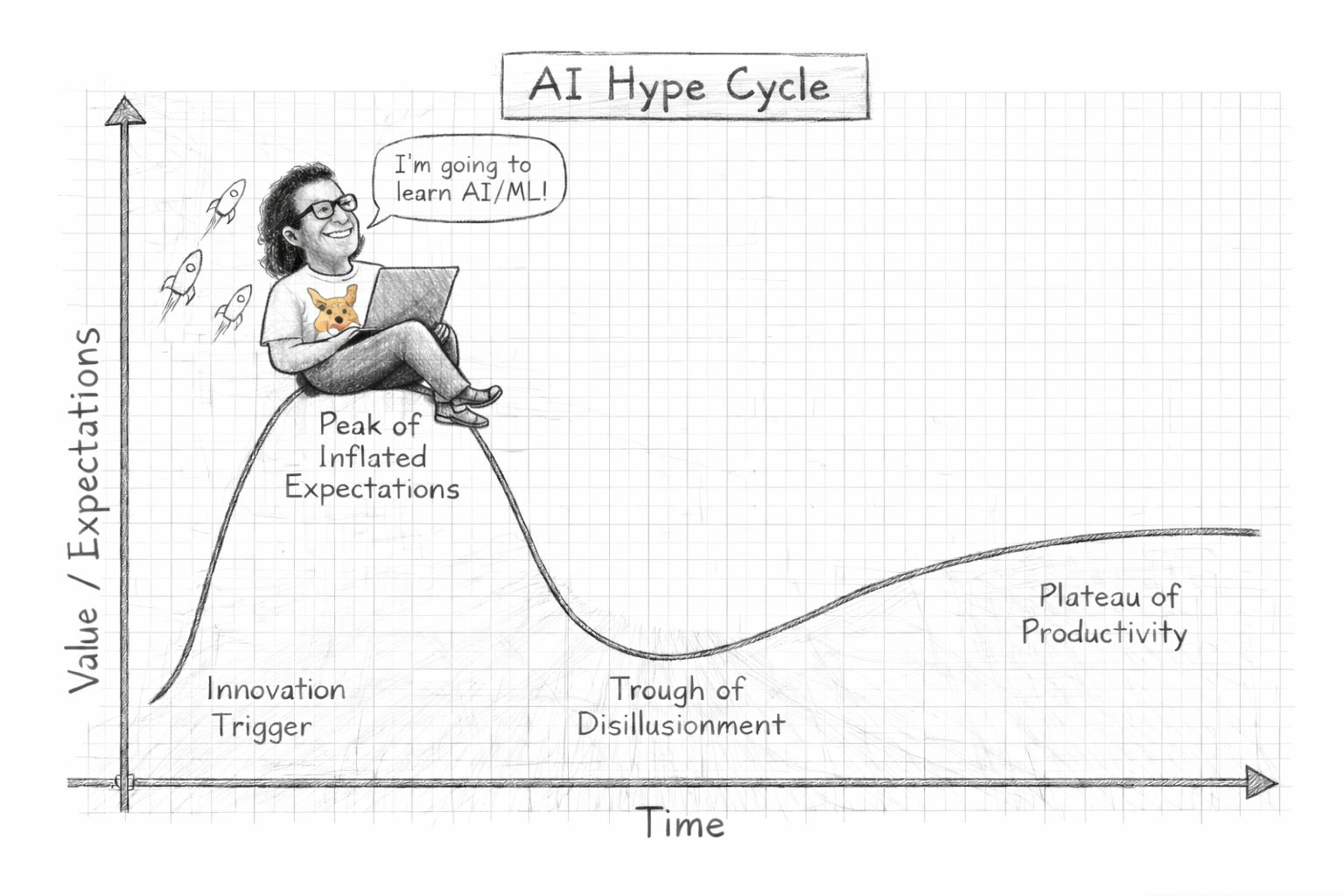
For my graduate degree, I specialized in AI/ML (artificial intelligence and machine learning) pursuing an MS in computer science at WGU (Western Governors University in Utah). Progression at WGU is based on demonstrating competency through successfully completing industry-level projects. The deliverables are aligned with my expectations of a senior software engineer in terms of both coding and technical documentation. Since I lacked that knowledge in ML, I first spent a month learning the fundamentals. After that, I spent a month completing projects and essays for the degree.
Step #1: Learn ML, AI and data science engineering.
Based on advice from Marina, I tried DataCamp, which ended up being perfect for my hands-on learning style. DataCamp courses teach new concepts through writing code. I started by learning the basics of python and data engineering (numpy, matplot/SNS, and Pandas). Then I moved into foundational ML concepts around supervised, unsupervised and deep-learning. And finally, I tackled specialized topics like NLP, RL, MLOps, statistics, and FinTech.
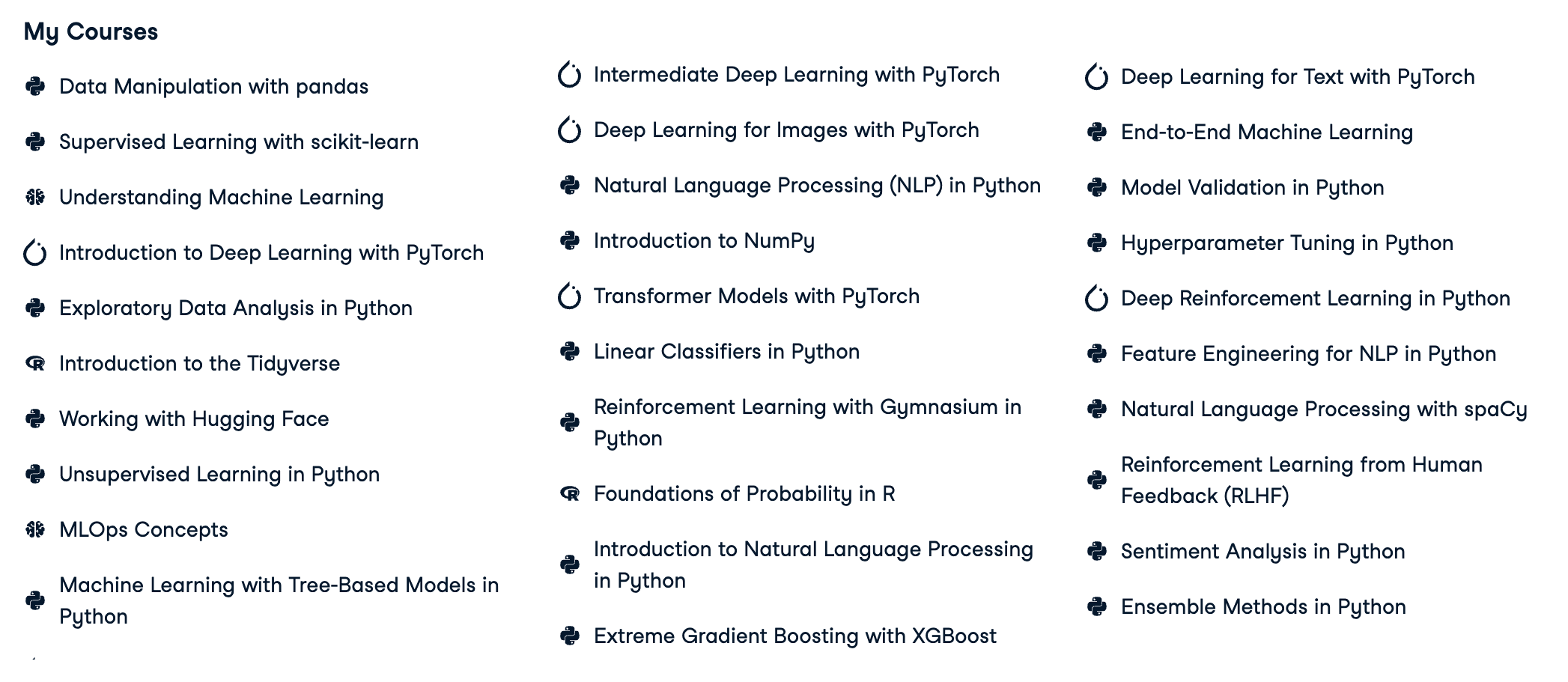
I nailed down a process that allowed me to finish a few courses every day by having ChatGPT convert DataCamp courses to educational and interactive projects. A DataCamp course includes approximately 20 videos on interlinked topics followed by coding exercises. Watching videos is a bit too slow for my pace as I learn best from technical documentation. Each DataCamp course also offers downloadable PDFs capturing the concepts, slides and code relevant to that course. To accelerate that process, I feed the course PDFs to ChatGPT, have it generate a Google Colab notebook that teaches me concepts, watch videos whenever I’m fuzzy on concepts, and start coding. These projects really shine for me because they’re real code I can read, debug, and modify, which fits my learning style. For those interested, here are the generated Python notebooks covering DataCamp topics.
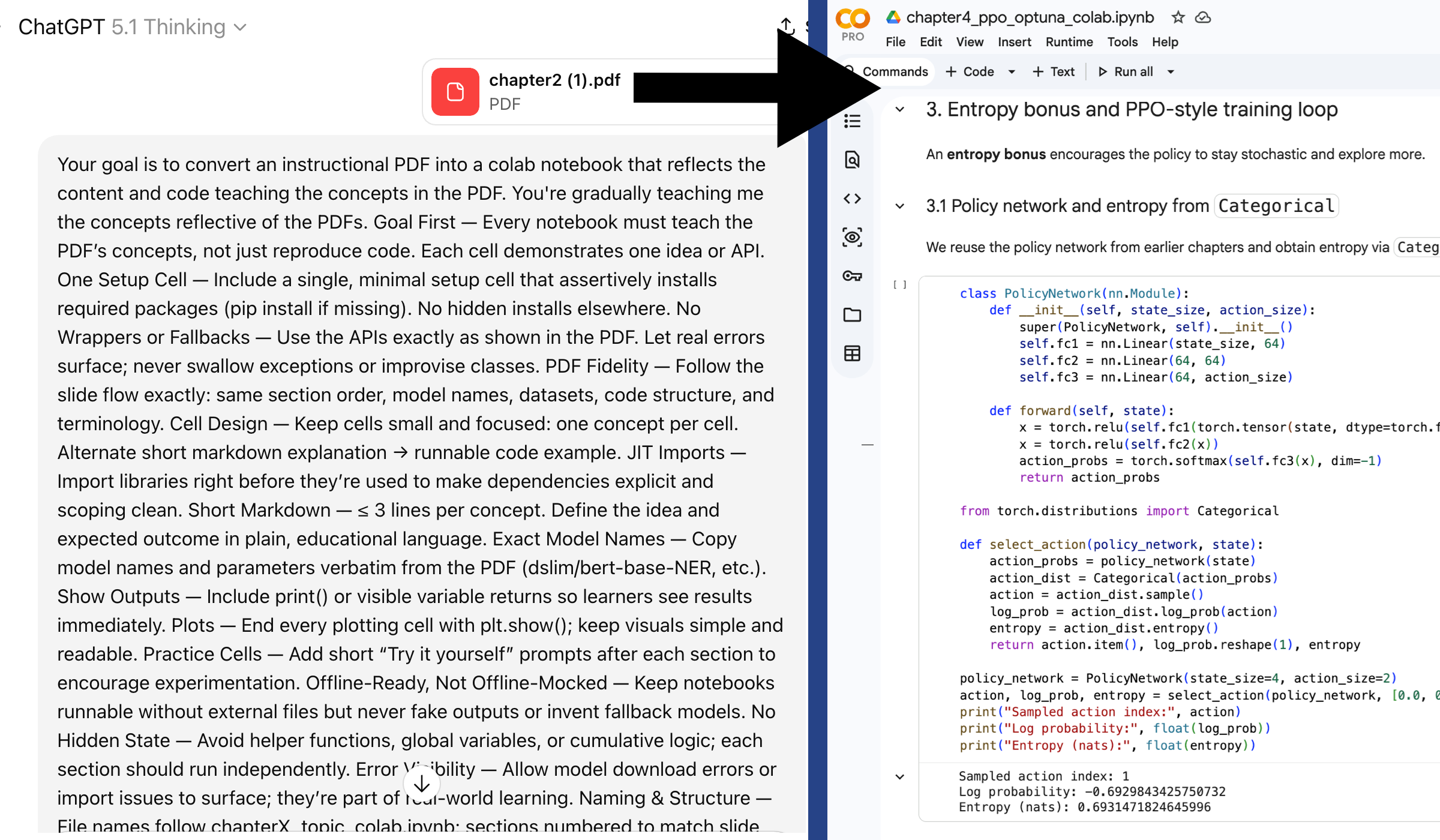
DataCamp is an effective teaching modality for applied AI/ML. WGU tuition actually includes complete unlimited access to DataCamp, Udemy and LinkedIn courses. Even better, WGU’s curriculum materials reference specific DataCamp courses, which made it straightforward to figure out the correct sequencing.
Step #2: Complete non AI/ML coursework
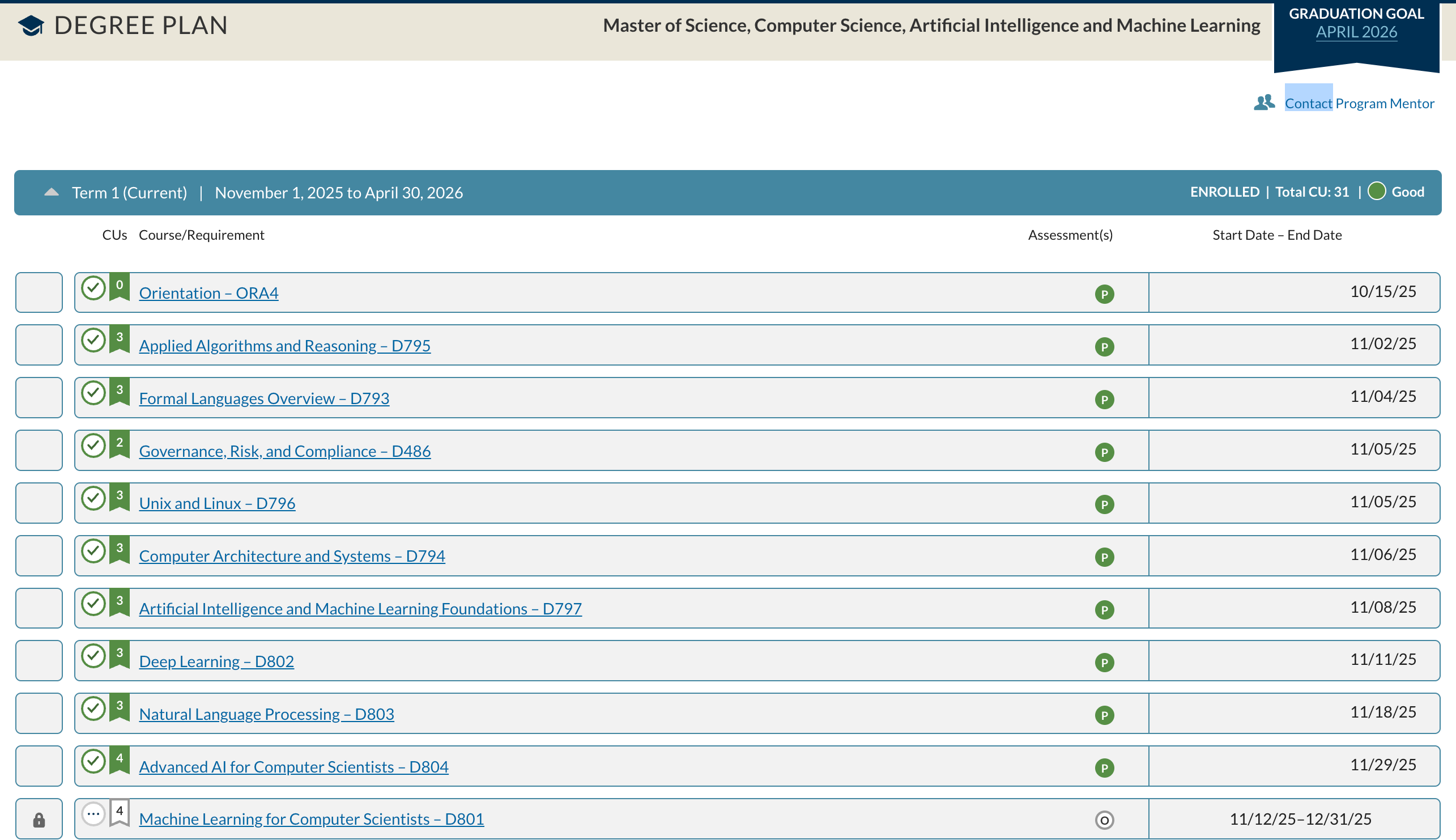
Roughly half of WGU’s MS-AI program covers software engineering: algorithms, architecture, scripting, coding, programming languages, and methodologies. My guess is that a 22-year-old graduate student would find these courses challenging and time-consuming. Given my extensive background as a software engineer with twenty years’ experience, that wasn’t especially challenging and I completed this portion in under a week. These were all non-trivial project assignments such as coding pathfinding algorithms, automating unix remote servers, and authoring corporate-level security documentation. These are all things I’ve done professionally during my career.
Step #3: Complete AI/ML coursework
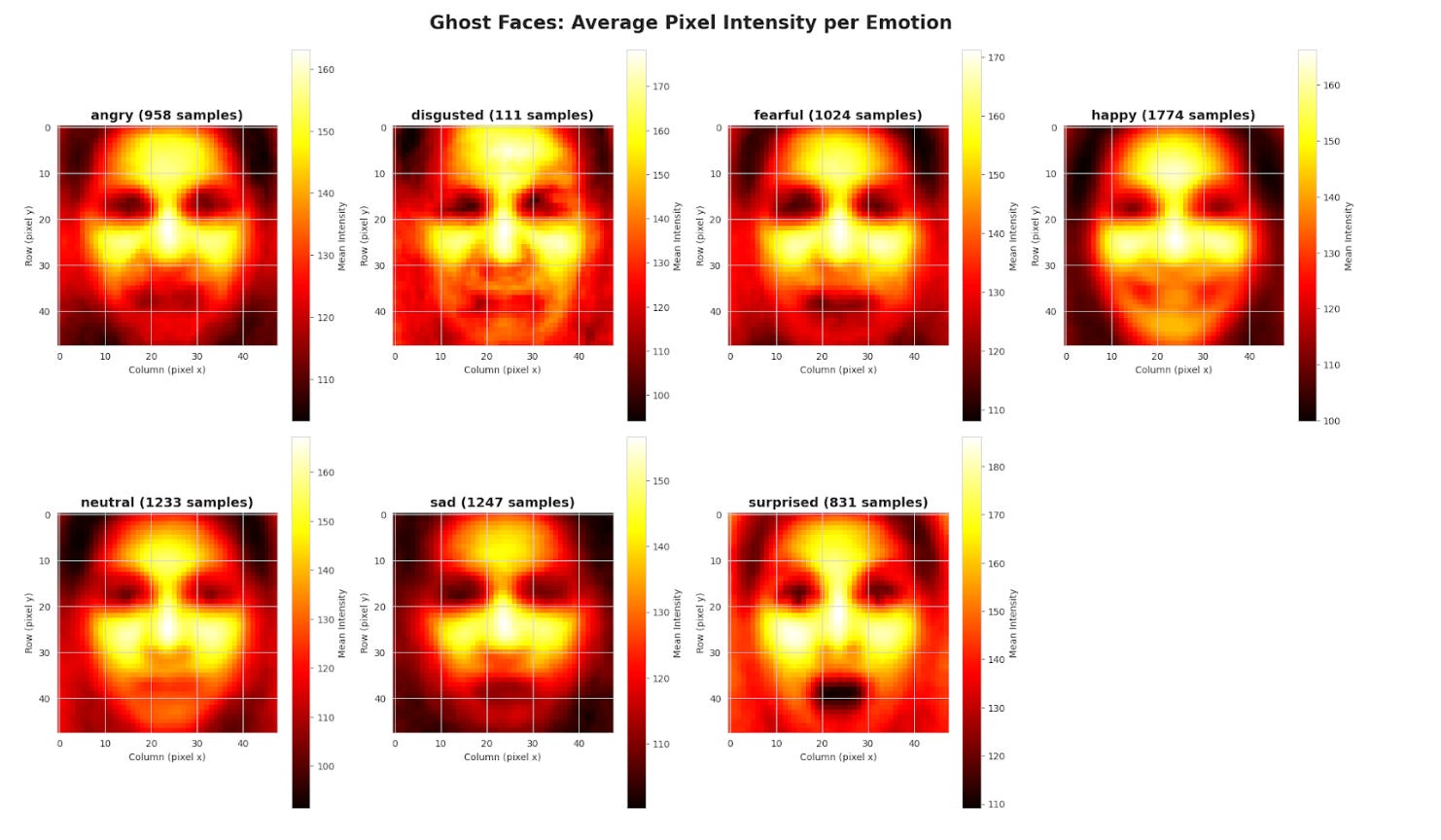
The more challenging half of the degree focused on AI, ML, NLP, RL, and DNN. I spent twelve hours daily coding up projects and writing graduate-level papers analyzing them. It’s a real joy to have someone care about my toy projects as I mastered AI/ML. I was genuinely happy getting positive feedback from WGU graders on my critical analysis of a saliency map for my XGBoost-based facial sentiment analysis final project. This portion of the degree culminated with an AWS certification testing practical ML engineering and operations.
Was this master’s worth it?
Yes, and No. It’s nuanced.
Yes, because having WGU set up the goalposts created urgency that up-leveled my technical skillset. Ultimately, WGU’s graduate degree is focused on improving AI/ML engineering skills and it achieved that for me. It brought into sharp focus which parts of ML’s vast historical knowledge are must-haves. The degree curriculum separated the wheat from the chaff of ramping up on AI/ML fundamentals.
No, because I’m ambivalent about whether this path makes sense for other software engineers. I could’ve just learned all those concepts, written all that code, and analyzed all those results without any structure or guidance. And if the tuition of a single semester at WGU is too much for you, you can probably do that. However, I’d find it depressing to grind in isolation on a self-derived AI syllabus. Trusting an expert-led curriculum felt reassuring.
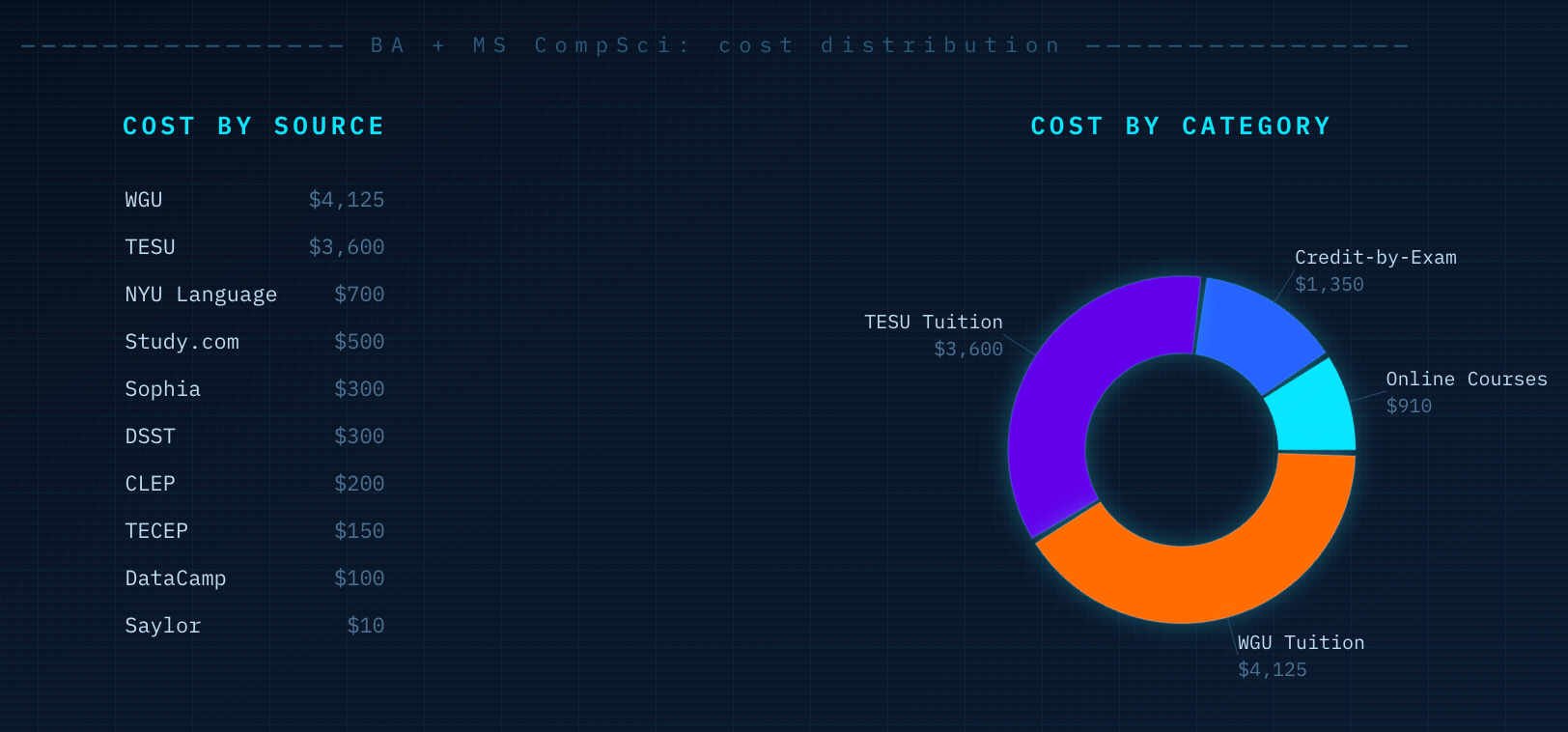
How much did it all cost?
Graduate degree: ~$4,225
WGU single semester tuition: $4,125
DataCamp subscription: $100 (included with WGU tuition)
Google Colab Pro: free 1/yr with EDU emails
Undergraduate degree: ~$5,880.
TESU tuition for two courses (6 credits) or a pack for 15 credits: $3,600
Graduation fee: $300
Sophia online courses (3 months, 29 credits): $99 x 3 = ~$300
Study online courses (2 months, 15 credits): $250 x 2 = $500
Saylor online courses (6 credits): $5 x 2 = $10
NYU credit-by-exam (language proficiency, 16 credits): $700
CLEP credit-by-exam (2 exams, 9 credits): $200 (could be free through Modern States)
DSST credit-by-exam (3 exams, 9 credits): $300
TECEP credit-by-exam (1 exam, 3 credits): $150
Note: this doesn’t take into account TESU’s accelerate fee or potential optimizations around it.
What’s next?
If you’re a software engineer considering your game plan in a world where code has no intrinsic value: go deep-dive into AI/ML. If you’re wondering if you need a degree: you probably don’t. For me, I found the structure and gamification of an expert-led curriculum grounding and supportive.
I had the immense privilege of pursuing an education without career pressure. I'm considering another master's from CU Boulder focused on AI/ML research (about 50% complete), or possibly coursework from Stanford or JHU on LLMs and mechanistic interpretability. Maybe I’ll undertake research and pursue publication. In the context of my life, following my passions has historically led to positive outcomes.
Next month I’ll be hosting a free full day build-your-own-LLM workshop in San Francisco. Drop a comment if you’re interested in attending in-person or want to see me post a recording here.
— Justin